
Table of Contents
Digital Tokenized Loyalty Programs Are Entering Their Value Era
Loyalty was built for a purpose that is limited to the coupons, not to create a long-term valued relationship. These were repetition, not contribution; redemption, not recognition. As customers mature, there is a need for Tokenized Loyalty Programs tobecome an integral part of the system. It changes the foundation and reforms the old practices.
They convert loyalty from a short-term incentive into a long-term asset. The best part is that it’s programmable, provable, and portable, so its value compounds for both brands and customers alike. In mature markets like the US and UK, where trust and retention determine sustainable growth, this shift is not cosmetic but architectural. Consumers do not leave because discounts are not large enough.
They leave because recognition feels transactional and temporary. When loyalty becomes an asset, recognition becomes credible, and then automatically it grows members’ experience continuity, status and utility. For leadership, the economics shift as well: retention stabilises, forecasting improves, and growth is governed by design rather than hope.
Why Tokenized Loyalty Programs Are Reaching A Turning Point In 2026
For years, loyalty programs survived on moments rather than meaning. Points were issued, redemption was encouraged, and breakage was quietly accepted as part of the model. That model works where the situation includes cheap growth, fragmented data and customer-tolerated transactional recognition. But these situations are no longer in the spotlight, and the change does not lie in consumer patience rather in its economic and operational reality surrounding the loyalty aspect.
That’s why there is a need for Tokenized Loyalty Programs to be no longer hit and trial rather structurally inbuilt to how markets now behave. Customer acquisition costs in mature markets such as the US and UK continue to rise, while privacy regulations and platform shifts have led to less certainty over precision targeting. Simultaneously, the evolving environment is shifting the customers and making them selective about how they invest attention and trust.
They are not seeking incentives for their efforts, but want a system that thoroughly recognises the contribution over time. So the aspect of the loyalty program must go beyond short-term marketing tactics and operate as a durable relationship layer where loyalty tokenization begins to matter. Internal pressure reinforces this shift. This kind of shift is moving to an extent where it cannot step back because of the internal pressure.
Sectors include finance and compliance questioning over the opacity of the system and rising unclear liabilities. It is because traditional systems are decreasing the trust; in contrast, Tokenized Loyalty Programs provide clarity that your contribution must be reintroduced as an asset with enforceable rules. It is then supported by token-based reward systems and practically through blockchain loyalty benefits, which will be the value that is portable, provable and fair. This convergence decides the future of loyalty economy, it is a revolutionary move from disposable incentives to asset-based participation designed for preserving the value.
Why Tokenized Loyalty Programs Fix Their Core
Traditional schemes fail for structural reasons, and we need to go into the details that provide overall clarity. Understanding the fundamentals will show where we are losing and winning. It will let us know the exact potential of the rewards we earn after contributing so much to different actions.
- First, they degrade; points lose value or disappear over the period of time.
- Second, they are siloed; that means no exchange, no use of the Wise platform. In a simpler format, value cannot travel beyond the brand or channel.
- Third is no transparency; customers cannot see real utility, and finance teams can’t model real liability. Finally, you can see that there is a trust gap; people forget, or sometimes it is just there, no use, because of the limitations.
An architectural answer does not add another dashboard; it changes the record of value. With Tokenized Loyalty Programs, loyalty is represented as a digital asset whose rules are verified and upgradeable. The rules do not hide in PDFs; they live as enforceable logic that both customers and auditors can rely on. This is the reason loyalty tokenisation matters; it enhances the old system.
At PrimaFelicitas, we have experience and can clearly state that the approach creates a strong ecosystem. It involves positive key components: measurable retention, predictable liability and transparent value exchange. Schedule a meeting to build a tokenised system that pays respect to contributors’ loyalty with value access. The approach elevates benefits from marketing language to operational truth. It also restores confidence internally; CFOs see obligations clearly, and compliance can verify changes.
Why Now: Market Conditions Favour Asset-Based Loyalty
US/UK customer acquisition costs are rising. Privacy changes have made targeted performance marketing less predictable. Premium consumers increasingly assign value to access, not just discounts. Meanwhile, brands want retention economics they can forecast with confidence. Tokenized Loyalty Programs meet these pressures directly by converting benefits into programmable, transferable and provable.
- With programming, they can be tailored.
- With transferable utility grows across contexts.
- With provable finance, risk can be modelled while customers can trust outcomes.
Two macro signals are pushing leaders to act. First, a shift from transactional identity (email and cookies) to verifiable relationship signals that can easily channel changes. Second, a shift from discounting practice to status, exclusivity and experiential tiers. It is a kind of value that compounds with time. So keeping this together makes a paradigm shift, which creates a system where loyalty programs is a growth platform. It is not at all a cost centre to be optimised quarter by quarter; 2026 is all about choosing whether to remain relevant as expectation matures.
What Exactly Is a Tokenised Loyalty Program?
In simple words, tokenisation is a structured representation of rights and rewards. For instance, think of a membership coin or key that encodes access rules like early product windows and dedicated support. It also supports upgrade logic, which means how status advances and redemption conditions, which means what unlocks experiences. Because the logic is explicit and the record is tamper-proof so that both brand and member operate with full clarity. That is the practicality behind blockchain loyalty benefits. It supports no disputes, cleaner accounting and an experience that can be explained in human terms.
A token is not a promise hidden in terms, but rather a pack of values. A container of value that can travel, evolve and be recognised across properties. Not only this, but also across channels, marketplaces, and even curated partners. When the program has been designed responsibly, it becomes a privilege passport rather than a coupon stack. We can say that it is the trajectory of the future of loyalty economy in which the benefits are gained over time instead of quietly evaporating.
How Tokenized Loyalty Programs Change The Economics
When value is provable, and pricing reflects merit rather than marketing, it is time to close contracts because risk is clear. Now the disputes fade because the records are speaking for themselves, so the team needs to focus on designing experiences instead of defending decisions. This is where token based reward system build their business case. They reduce friction, increase perceived fairness and create enduring reasons to stay that are stronger than any discount. Members also behave differently when status feels earned and portable.
Think for a while: if privileges are durable and tiers reflect meaningful contribution, then the usage stabilises and advocacy rises. For different sectors like finance, where it replaces guesswork with event-driven liability. If it is a brand, then tokenised tiers bring stickiness without aggressive discounting. For brand tokenised tiers, bring stickiness without implementing any aggressive discounts. Whereas consumers feel that loyalty is like belonging, not bargaining. Midway through any transformation, this single idea frames the intent. Tokenized Loyalty Programs are how brands move from short-term promotions to long-term participation.
Design Principles That Separate Leaders From Experiments
Start with utility, not novelty; the token must entitle practical privileges, priority windows, exclusive inventory, concierge returns, learning tracks or community access. If these benefits cannot be explained briefly and concisely, then they can be memorised. This is the governance lens of loyalty tokenization in practice. The rules must be encoded in human verse. So that it can be easier to understand for the consumers.
Along with that, in the backbone of the system, program logic enforces them consistently. This pairing is the true engine of blockchain loyalty benefits. Contribution must be rewarded, not like a game, but with an actual value-driven reward. Using artificial intelligence to measure engagement quality, not just quantity. It is very simple to register that members respect systems that respect them. There should be an equilibrium between scarcity and inclusivity. Premium tiers can be limited, but core benefits must be in check and welcome the customers.
This equilibrium protects the brand while growing the community and aligns with the future of loyalty economy you intend to build. Plan for partners from day one. Value compounds when privileges travel across a brand family or curated alliances. This is where token based reward systems become a network, not a silo.
How Tokenized Loyalty Programs Change The Economics
The economics of loyalty change the moment value becomes provable. Traditional programs are full of assumptions because points expire, rules shift over time, and liabilities are difficult to forecast. This level of uncertainty pushes the teams to endorse short-term tactics rather than thinking about the big picture. That picture comes after having Tokenized loyalty programs that replace that uncertainty with structure.
When loyalty is not all about participation, but is an asset that must be valued and governed. Finance teams can see where the obligation has been made and what it represents, and how it can be redeemed. This visibility turns loyalty from just a marketing perspective to a system that is planned, measured and improved. This can be possible through loyalty tokenisation where recognition transforms from an abstract promise to a defined economic instrument.
This also shifts the customer behaviour. Alongside this shift, it also rewards become durable and earn, which plays a steadier engagement. They move with progress status rather than just discounts. To support this behaviour, Token-based reward systems started to reward contribution over volume, which improves retention without eroding margins. All the operations are transparent, which brings clarity over the disruption that declines day to day statistics between consumers. It keeps all data with blockchain so that every action can be verifiable and changes are transparent, removing the need for constant checks. So this is the future of loyalty economy that values assets and brings customer motivation, financial discipline and long-term growth together.
Sectors That Can Move First And Win Quickly
Retail and lifestyle sectors can replace generic discounts with tiered access that is completely structured. The tiered access includes release windows, exclusive product drops, concierge-level exchanges or personalised styling experiences. This makes customers feel genuinely valued while protecting margin integrity and premium perception.
Other sectors, such as travel and hospitality, can unify loyalty privileges into upgradeable entitlements. This entitlement works across multiple hotel brands, airlines, vacation networks, and curated partner lounges. This creates a sense of status among customers that these privileges will come wherever they go, instead of resetting every time they switch providers.
Education and Professional Learning include course completions, exam results, contributions to communities and participation in live learning events. This participation can be converted into Tokenized Loyalty Programs include mentorship access, alumni networks, premium content tiers, etc. This skyrockets the education and makes it a continuous value relationship, not a single transaction.
In the Gaming and Entertainment industries can be gain trust and as much as customer retention. On the other hand, customers also get the best experience through loyalty tokenization, including in-game experiences and real-world participation advantages. Instead of getting temporary points, members get season passes, digital collectables or event-based access.
The tech industry includes B2B software and services used to provide enterprise buyers with value, reliable continuity, outcome accountability and priority support above everything else. With tokenised tiers, brands can guarantee response time commitments, roadmap previews, technical escalation recognition or direct product leadership sessions. These privileges will be recognised by the teams and appreciated by them. That can be justified in strategic purchasing decisions.
Governance, Compliance And Risk
No credible program launches without guardrails. Set issue rights (what changes and how they will be done). The member protections, like notice period and grievance paths, will be issue and integrating auditability includes independent verification. The new system will align with consumer protection and digital asset guidance in the jurisdictions you serve. A well-run program treats compliance as a design input, not a post-launch patch. The same approach and practice support financial integrity: recognise obligations when they are created. They also avoid exploitative breakage and sunset rules with dignity. It is time for the programs in which members respect their rules to earn respect in the market.
Implementing Tokenized Loyalty Programs: A Practical Roadmap
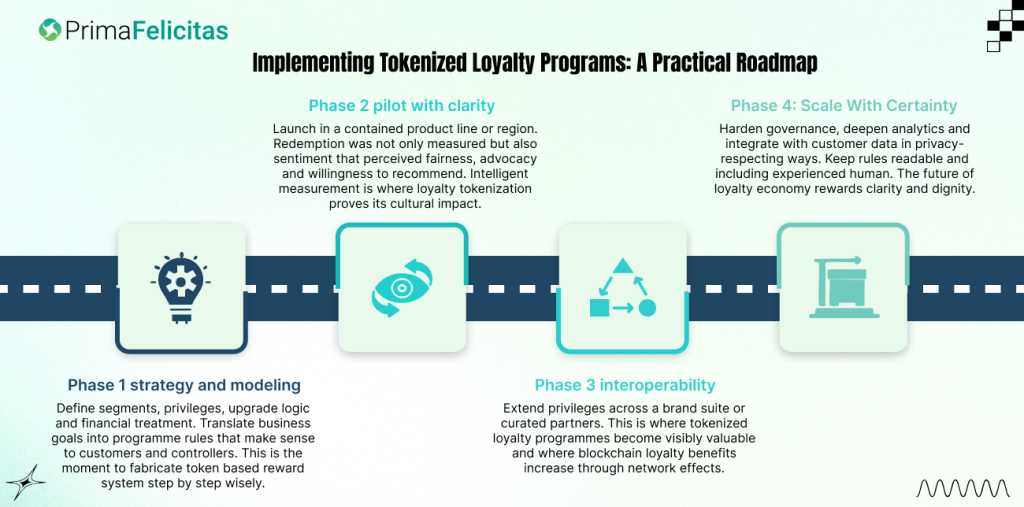
Phase 1 strategy and modelling
Define segments, privileges, upgrade logic and financial treatment. Translate business goals into program rules that make sense to customers and controllers. This is the moment to fabricate token-based reward system step by step, wisely.
Phase 2 pilot with clarity
Launch in a contained product line or region. Redemption was not only measured but also sentiment that perceived fairness, advocacy and willingness to recommend. Intelligent measurement is where loyalty tokenization proves its cultural impact.
Phase 3 interoperability
Extend privileges across a brand suite or curated partners. This is where tokenized loyalty programs become visibly valuable and where blockchain loyalty benefits increase through network effects.
Phase 4: Scale With Certainty
Harden governance, deepen analytics and integrate with customer data in privacy-respecting ways. Keep rules readable and include an experienced human. The future of loyalty economy rewards clarity and dignity.
What Customers Actually Feel
Customers do not speak in acronyms. They can use that value when it is necessary. In an asset-based program, status is acknowledged without negotiation. Access is meaningful rather than performative, and the brand’s intent is legible. When the program’s truth is written in code and visible in records, membership stops testing the system and starts trusting it. That emotional clarity becomes commercial power.
What Leadership Actually Gains
They go through the positive outcomes like clarity over liability, control over rules, and confidence in forecasting. A credible story for investors and regulators. And most practically, a program that marketing, finance and data teams can stand behind together. When tokenized loyalty programs are implemented thoughtfully, leadership spends less time reconciling and more time innovating. The board sees retention as an asset with predictable return, not a cost with unpredictable breakage.
Keep The Tokenized Loyalty Programs Compounding
Programs fail when they vanish because they are forgotten. There can be a reason they are ignored or overlooked due to some situations. Once they are launched, they are left unchanged, because of which the value gets deprecated, and nobody cares. So to keep that alive, brands must regularly refresh the benefits that matter and remove unnecessary privileges. There should be an ecosystem for the customers that move from occasional participation to deeper, committed membership.
AI and Data Intelligence should be implemented to monitor the engagement, not just activity volume. The system will make sure that there is not just activity volume but also that the system stays fair to all participants. This is how Tokenized Loyalty Programs remain meaningful, valuable and trusted over time instead of turning into marketing gimmicks. This continuous updation of the loyalty programs as per the consumer will bring justice to both the giver and taker. And it truly shapes the future of loyalty economy, not as a one-time launch but as a long-term evolution.
Continue The Journey: Align With AI And Blockchain
If you are ready to convert your contribution and loyalty into a durable value. And want to align program design with the technologies that make fairness operational. Then it is necessary to include AI and blockchain together to support different key points. These are verifiable deliveries, smart agreements that reduce scope risk and transparent approvals that cut dispute cycles. When those capabilities are combined with Tokenized Loyalty Programs, then they form a trusted backbone. Where every contributor can feel the value and importance. Along with that, the finance team can validate. In practice, this is where blockchain loyalty benefits move from concept to confidence.
Leadership Takeaway
You do not need to replace the brand to modernise loyalty. There is only a need to replace the assumption beneath it. And what is that? That value should expire, recognition should be generic and that fairness is too complex to promise. With the right architecture, loyalty becomes a privileged platform, clear in its rules and generous in its spirit. There should be discipline in its accounting. For US and UK enterprises, this is the standard the market will reward.
Conclusion: Loyalty, Upgraded To An Asset
The time has come when the era of disposable points is going to end. The next move is towards brands that give customers something they can truly hold. The value recognition that lasts, access that matters and value that can be proven through Tokenized Loyalty Programs. They convert goodwill into governed value and turn membership into meaningful relationships. Now the value grows stronger with time. If you want a partner who treats trust as architecture and designs programs where dignity and value move together.
If you are on the path of changing the perspective of loyalty. Then our team would be glad to align with your vision. Looking forward to connecting with you.
