
Table of Contents
Strategic Framework to Structure Compliant & Investor-friendly Real Estate RWA Tokenisation Models
Real estate is an imperishable asset investment, an ever-increasing value that offers security with the right investment. The sector is huge and diversified, combining various vertices like land, buildings, design & construction, lending and trading for investment. Traditional real estate trading involves multiple intermediaries and third- party involvement that makes documentation, settlements and trading complex. Blockchain-backed Real Estate RWA Tokenisation helps overcome challenges linked with real estate trading.
Asset tokenisation enables estate owners to convert the assets into tokens and offer fractional ownership to buyers. This opens up an opportunity for investors to buy real estate assets in the form of a token, each representing a certain real value.
In fact, real estate RWA tokenisation is already one of the top use cases of blockchain and tokenisation technology. A survey with 750 CFOs at major companies worldwide, reported by Statista, shows that 12% of real estate firms were already using tokenisation. 20% stated that they were in the early-stage adoption phase, and 26% were running blockchain pilot projects.
Various surveys suggest that real estate is expected to become one of the largest sectors using asset tokenisation technology, covering 30% of the overall market.
Read on to explore the real impact of RWA Tokenisation in the real estate market, unlocking new investor segments and faster liquidity.
Real Estate RWA Tokenisation: Simplifying Ownership and Trading
The convergence of blockchain technology in the real estate sector has given rise to the RWA asset tokenisation concept, a revolution in the real estate assets trading. The new age real estate regulated trading platforms enable seamless trading of properties in the form of tokens. Many countries and leading real estate organisations are already using digital blockchain systems for land registry and real estate assets trading.
For example, Sweden’s land registry authority has been running a pilot project in collaboration with private companies since 2016. It helps them maintain a tamper-proof system for property records.
Real Estate RWA Tokenisation is a novel pathway for real estate investments. Let’s see how–
- Enhanced Liquidity: RWA tokenisation converts the illiquid real estate assets into fractional digital tokens that can be traded on a regulated trading platform.
- Support in the Country’s Economic Landscape: The selling and buying process becomes easier, which increases the overall global investment that adds to the economic growth of the country
- Transparent and Fast Transactions: Minimal intermediary involvement makes the process fast and transparent as compared to traditional trading.
- Global Investment Opportunity: The platform reduces entry barriers for investors and opens up global participation and opportunities.
- Accessibility for investors from Multiple Domains: Investors from diverse fields and backgrounds get an opportunity to invest in real estate assets conveniently.
Explore what the Co- founder and blockchain and tokenisation expert at Primafelicitas has to say about-
Let’s look at some of the other benefits of using smart contracts with the tokenisation process-
Smart contracts replace the traditional paperwork and automate processes such as-
- Verification of legal obligations
- Pre- approved secure payment
- Transfer of property document
The immutability feature of blockchain platforms ensures that–
- Documents are not altered or tampered with
- Prevent fraud due to duplication or tampering of real estate records, thus preventing fraud
How Real Estate Companies Can Structure RWA Tokenisation for Global Investors?
Real estate companies can collaborate with blockchain digital solutions development companies to deploy smart contract-backed real estate RWA tokenisation systems. Here is a comprehensive guideline for the successful implementation of the platform with the right planning and strategy.
- Property Selection, Due Diligence & Valuation: Include properties with a clear title, strong valuation, and stable cash flow. Determine the property’s current market value to serve as the foundation for pricing the tokens accurately.
- Legal Structuring of Assets: Structuring refers to converting the asset into a token- friendly format. It is advisable to choose Special Purpose Vehicles (SPVs) to link the tokens legally to real estate ownership rights. Maintain and report on investors’ relations, and ensure tokens comply with country-specific token trading. This structure ensures that Real Estate RWA Tokenisation remains legally sound and attractive to institutional investors.
- Choose the Right Blockchain or DLT: Cryptic, immutable, and automated characteristics of blockchain technology facilitate secure transactions and fast settlements without multiple follow-ups. Leverage a blockchain infrastructure to maintain transparency and scalability.
- Token Creation & Issuance: Design an RWA token that complies with blockchain network standards and is compatible and interoperable across decentralised exchange(DEXs) platforms and digital wallets.
- Regulations & Legal Framework: Ensure compliance with the relevant regulatory framework that clearly defines the rights and responsibilities of token holders.
- Distribution & Trading: Follow the regulatory framework to distribute the token to investors either through private sales, public offerings, or auctions. Further, listing a token on the secondary market helps expand trading and provides liquidity to token holders. A well-planned distribution strategy is the backbone of any successful Real Estate RWA Tokenisation project.
Planning to integrate RWA Tokenisation systems with your real estate business? Connect with our team of blockchain and tokenisation experts at PrimaFelicitas.
Partner with us to build a secure, reliable and scalable real estate RWA Tokenisation system.
The blockchain platform and smart contracts act as the foundational infrastructure enabling automation, security, and operational efficiency.
- Deploy Secure Smart Contracts: Automate token distributions and define transfer rules using verified and approved smart contracts. Reduce manual intervention, improve efficiency, and add trust in the trading process.
- Implicate Tax Framework for Global Investors: Clarify cross-border tax implications with global trading of tokens. It will prevent them from paying extra tax and enable you to build strong trust with global investors.
- Define a Seamless Digital Investor Onboarding Process: Build a system that offers easy identity verification and accreditation checks.
- Asset Management & Servicing: Regularly check for property maintenance, verify asset authentication, manage rent collection, and facilitate dividend distributions.
- Risk Management & Transparency: Despite the various advantages of real-world assets tokenisation, the process can add risks and challenges if regulatory compliance and audits are not met. Ensure to maintain regular reporting and keep performance updates to avoid risks.
- Define an Exit Strategy: Let the investor have clarity on asset resale, refinancing, or structured buyback programs. Clearly outline the exit path to gain investors’ confidence and prepare for long-term strategic planning.
Read the blockchain to learn the-
| Tokenisation Services: Unlocking the Future of Digital & Real World Assets | Tokenisation: Challenges, Solutions and its Future |
Technology Behind Real Estate Tokenisation
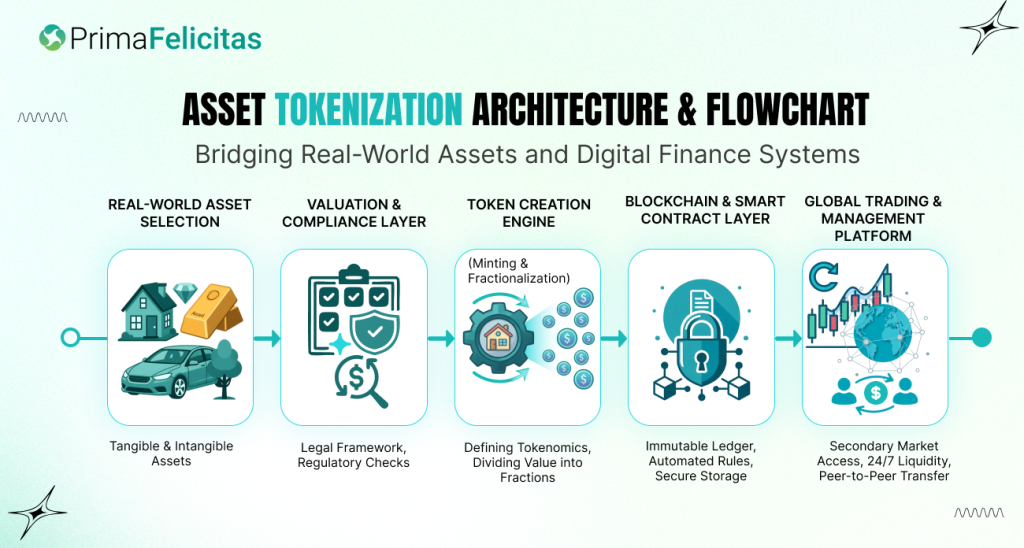
The property value is divided into digital tokens using Distributed Ledger Technology (DLT), and each token represents fractional ownership that can be traded on digital platforms.
Type of Network
DLT can be permissioned or permissionless. The type of DLT used plays a crucial role in maintaining transparency, accessibility, and regulatory compliance with the entire process.
For Real Estate RWA Tokenisation, a private or public permissioned network works best as they follow regulatory compliance, which is critical for real estate trading.
- Private Permissioned DTL for Real Estate Tokenisation: It allows accessibility to only selected participants or investors. The approach limits token interoperability. Usually, it is controlled by a single organisation or selected group, such as real estate platforms or a consortium managing investor records.
- Public Permissioned DTL for Real Estate Tokenisation: The ledger is visible to the public, but only authorised participants can validate transactions. Useful approach for platforms that require public auditability but also need KYC to confirm identity for investors.
Role of Smart Contracts in RET
In the traditional approach, intermediaries such as real estate brokers, agents, and lawyers are involved. They assist property sellers and buyers in preparing contracts that define rights, titles, and rules.
Smart contracts eliminate dependency on intermediaries. The process is automated with verified and agreeable codes among the parties. Once deployed on the blockchain, the contract is immutable, irreversible, and functions independently.
Deploy secure smart contracts and automate real estate activities. Eliminate intermediaries and interventions, and help reduce fraud within the real estate ecosystem. Discuss your specific requirements with our team of experts at PrimaFelicitas.
Token Standards
Specific standards such as ERC-20, ERC-721, and proprietary protocols are implemented to–
- ERC-20: A technical standard that defines how the tokens are transferred, managed, and recorded on the Ethereum blockchain. It also ensures that the token is compatible with digital wallets, exchanges, and decentralised exchange platforms.
- ERC-721: Non-fungible token standard on the Ethereum blockchain that sets guidelines for creating unique tokens representing digital assets.
Real estate tokenisation helps set attributes such as fractional ownership, revenue-sharing
Mechanisms and voting rights. The proprietary protocols are a set of rules or standards created and controlled by the real estate company or organisation.
Compliance and Legal Frameworks
The real estate tokenisation platforms adhere to the regulatory guidelines, ensuring compliance with regional laws on property and its trading. A reliable platform follows the Know Your Customer (KYC) procedures rigorously to maintain market integrity and investors’ trust.
Interoperability
One of the most crucial features of a real estate token trading is interoperability to allow NFTs to interact with multiple applications and platforms. It enhances the overall utility and value of NFTs.
Governance for Decision-Making
Token holders can participate in the governance mechanism that allows them to participate in voting using smart contracts. It allows stakeholders to make appropriate decisions on property and assets management and strategic business initiatives.
How PrimaFelicitas Delivers Real Value in Real Estate RWA Tokenisation Projects
PrimaFelicitas believes in long-term commitment and offering comprehensive, value-driven services to businesses. With over 2 decades of experience in blockchain and tokenisation, we can offer the best tokenisation services to meet your specific needs. Connect with us for-
- End-to-End Tokenisation Consultation with Experts: Book a meeting with us to discuss your specific real estate digital solutions requirements using tokenisation.
- Implement Regulatory-Ready Tokenised Framework: We help businesses understand the KYC procedures for stakeholders, investors and real estate owners, and security laws and regulations related to property and tokenised procedures.
- By examining the blockchain infrastructure and market dynamics associated with real estate tokenisation, we provide a comprehensive understanding of its potential impact on the real estate market to our clients.
- Deploy Verifiable Smart Contracts for Automation: Our team of experienced developers can help you deploy secure and verifiable smart contracts to automate processes.
Operational Services: Deploy Scalable Future-Ready Tokenised Systems
- Customisable Tokenised Platform: We offer digital asset management services through automated, transparent blockchain infrastructure and smart contracts. After tokenisation, users can manage money collection, keep a track of record and ensure maintenance. Smart contracts automate processes such as money transfers and the screening process, thus reducing administrative overhead and manual processing.
- Tokenised Marketplaces and Exchange Platform: We can help you develop secure digital marketplaces to enable seamless trading of tokenised real estate assets. The platforms can enable investors to buy, sell, and trade tokens seamlessly
Contact us today for seamless integration of tokenised services with the existing real estate environment!
Also Read: Real-World Asset Tokenization: The Next Multi-Trillion-Dollar Market
Final Words!
The digital world is evolving rapidly across industries, be it real estate, healthcare, supply chain or the music and art industry. Why wait? Stay ahead, relevant and gain a competitive edge by starting with a pilot project using blockchain or tokenisation technology.
Book an appointment for a one-to-one consultation and discuss your specific requirement. Know in detail how to integrate real estate RWA tokenisation systems with your business environment.
